
In the global specialty coffee market, a recurring question arises among roasters and importers: How can a kilogram of Yemeni green coffee cost multiples of that from Brazil or Colombia?
The answer isn’t just marketing myth or historical nostalgia. It lies in a clear economic equation intersecting geographical scarcity, genetic diversity, harsh farming conditions, and real production costs.
What Distinguishes Yemeni Coffee? Quality Proven by Numbers
1-The Historical Legacy of Mocha
Yemen is the first country in the world to commercially export coffee to global markets via the port of Mocha in the 15th century. This gave rise to the term “Mocha,” which has been a global symbol of luxury coffee for centuries. This legacy establishes:
- Not just a historical dimension.
- A “Brand Origin” identity deeply rooted in the specialty market.
- Accumulated cultural and marketing value that is difficult to replicate.
2-Genetic Diversity of Ancient Heirlooms
Unlike most producing countries that rely on a limited number of high-yield commercial varieties, Yemen retains a rare genetic diversity of ancient Arabica heirlooms (e.g., Udaini, Dawairi, Tuffahi). International agricultural reports indicate that:
- Yemen hosts dozens of indigenous genetic strains.
- These varieties have not undergone intensive industrial hybridization.
- They evolved naturally over centuries of traditional farming.
This reflects directly in the cup through complex flavor profiles and distinct sensory characteristics sought by specialized roasters worldwide.
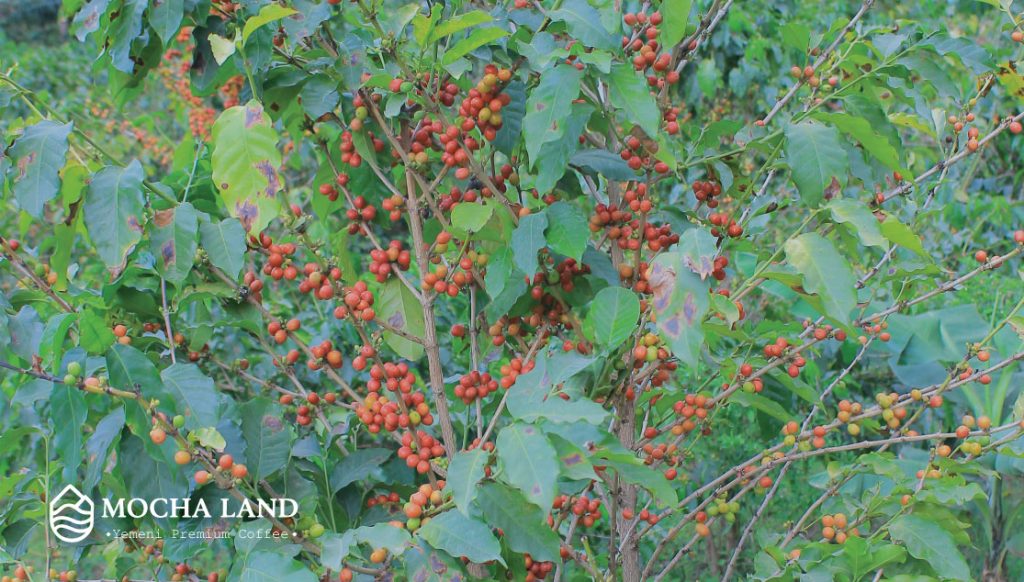
3-The Impact of High Altitude
Coffee trees in Yemen are grown at altitudes ranging between 1,000 and 2,400 meters above sea level—one of the highest coffee-growing ranges globally. These conditions lead to:
- Slower fruit maturation.
- Increased bean density.
- Higher concentration of natural sugars and acids.
The Result: Balanced bright acidity, richer body, and exceptional clarity in the final flavor.
Reasons for High Price: An Analysis of Production Economics
1-Global Scarcity
According to international coffee organization data, Yemen’s contribution does not exceed 0.1% of global coffee production, with an estimated annual output of only ~20,000 metric tons. In a market producing millions of tons, these figures make Yemeni coffee:
- A naturally rare commodity.
- Targeted exclusively at the Specialty Coffee market.
- Subject to high competition from a limited number of global roasters.
2-Low Yield per Tree & Logistics
Production in Yemen relies primarily on rain-fed agriculture and mountain terraces. On average, a Yemeni coffee tree produces between 0.5 to 1 kg of green coffee annually. Additionally, rugged geography creates massive challenges. Transporting harvest from remote areas creates logistics that can add 30–50% to export costs compared to other origins.
The Bottom Line: Is It Worth the Price?
For specialized roasters, Yemeni coffee is not just raw material; it is a rare origin with a true story. The high price is not artificial; it is the logical result of a clear equation:
Production Scarcity + Unique Genetics + Harsh Geography + Traditional Methods = Exceptional Value
For the serious buyer, it’s not just a purchase; it’s an investment in authenticity.